
Discoveries
A Hebrew blessing rolled into silver
Two tiny silver amulets from Jerusalem preserve an early Hebrew blessing. See the objects, read the ancient letters, and explore the research behind them.
In this article
A blessing small enough to carry
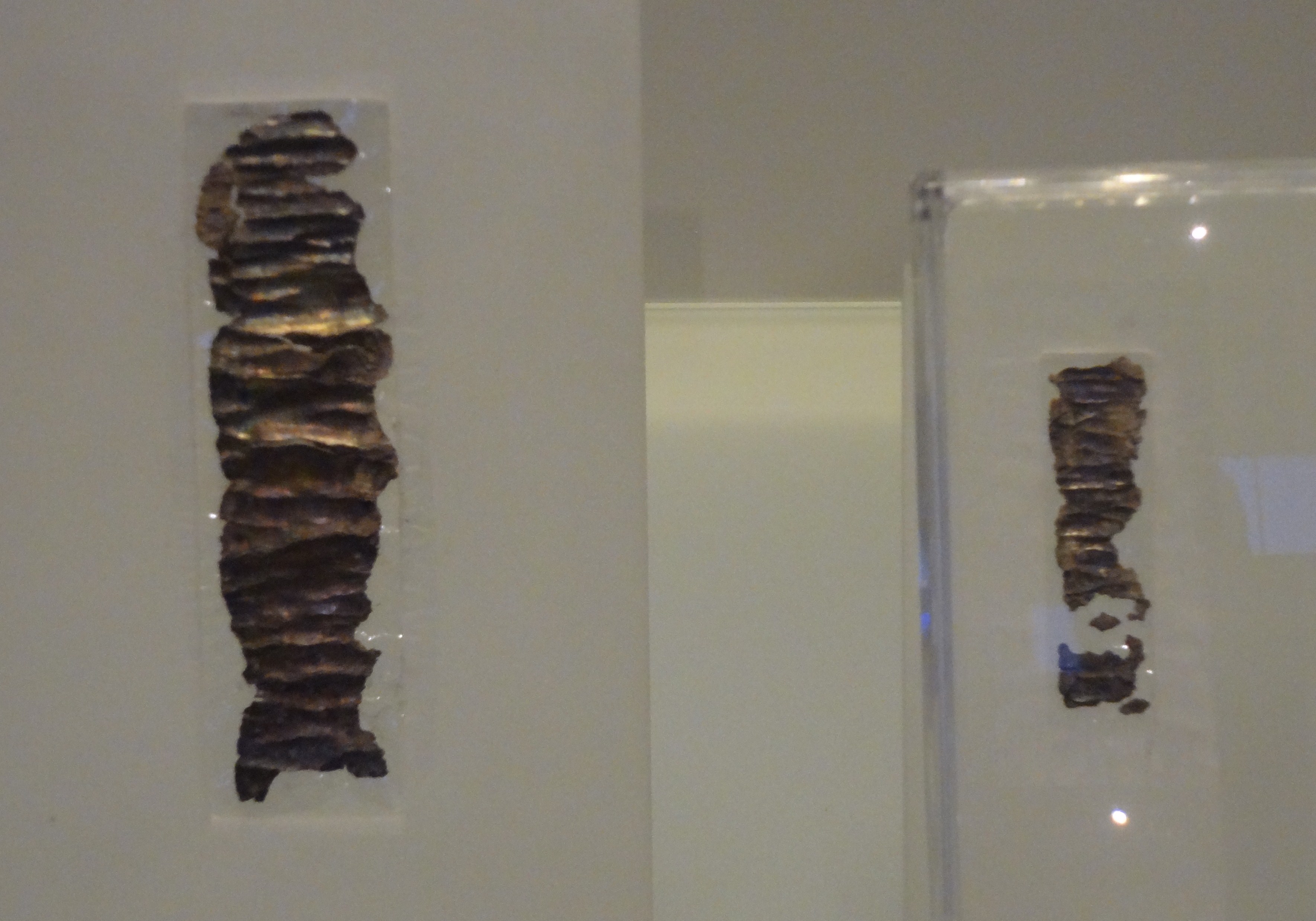
The measurement caught my attention first. The smaller of the two silver amulets from Ketef Hinnom measures only 3.9 centimetres high. Someone fitted a Hebrew blessing onto that narrow surface, then rolled the silver into a tiny scroll. The objects come from a burial cave in Jerusalem and are usually placed around 600 BCE. An amulet is an object that someone keeps or wears for protection; these two carry words asking God to bless and guard a person. [1] [2]
The photograph below shows them opened out, with the smaller amulet on the right. Their creased surfaces look fragile, yet they preserve an early form of the blessing familiar from Numbers 6:24-26, often called the Priestly Blessing. I wanted to understand how those familiar words fit onto such an unfamiliar object. [1]

Try the inscription
KH2: the closing blessing
Keyboard
Reading notes
Excerpt from KH2, lines 5-12, beginning with the blessing within line 5. Follows Smoak’s reading and line breaks. Brackets mark restored letters. Final letters use their base forms; editorial separators in the divine name are omitted. Source
Words wrapped in silver
Gabriel Barkay’s excavation team found the amulets in 1979. The site, Ketef Hinnom, lies southwest of Jerusalem’s Old City. Researchers call the larger inscription KH1 and the smaller KH2. The initials simply abbreviate the place name, and the numbers let us keep the two texts apart. [3] [4]
The University of Michigan’s object account suggests that a string could have passed through the centre of a rolled amulet so that its owner could wear it around the neck. That possibility helps me picture the object at its original size. Today we spread the silver out to inspect the writing; its ancient owner may have carried the words tucked inside the roll. [2]
The Israel Museum describes letters cut with an extremely fine stylus. Reading such marks takes care because damage can interrupt a stroke or remove a letter altogether. In their 2004 edition, Barkay, Marilyn Lundberg, Andrew Vaughn, and Bruce Zuckerman used high-resolution photographs to identify traces that earlier readings had missed. Their work strengthened the interpretation of the objects as protective amulets. [1] [3]
Reading the smaller amulet
The tool above follows scholar Jeremy Smoak’s reading of KH2’s closing blessing. It asks the Lord to bless and guard the recipient, shine his face upon them, and give them peace. Brackets mark restored letters. [4]
Try following the line breaks before joining the words. The first letter of ישמרך, “guard you,” sits at the end of one line; the rest follows on the next. Farther down, the writer splits the word for peace across the last two lines. The narrow strip sets the pace of the writing. [4]
You can copy the ancient characters, switch the display script, or open the passage in the converter. Keep the photograph nearby as you read. The typed text makes the sequence easier to follow, while the silver shows the cramped space in which the writer worked.
How old is the blessing?
The date matters because these objects give us physical evidence for the blessing’s early use. The 2004 research team argued for a date before the Babylonian exile, near the end of the kingdom of Judah. A 2024 corpus by Christopher Eames and Yosef Garfinkel also places the amulets in the seventh century BCE. The Israel Museum uses the sixth century BCE in its catalogue. For an introduction, “around 600 BCE” keeps that range in view. [3] [5] [1]
There has also been a more substantial disagreement. In 2011, historian Nadav Na’aman proposed an early Second Temple date, when Jerusalem’s Temple had been rebuilt after the exile, and linked his reading to hopes surrounding that building. Shmuel Aḥituv challenged that interpretation in 2012. His response favoured personal texts from the end of the First Temple period. Their published abstracts state the competing positions clearly; the bibliography links to both. [6] [7]
A familiar phrase can make an ancient text feel immediately settled. Here, the physical object, the damaged letters, and the proposed historical setting all need attention. I find the museum’s approximate dating useful as a starting point, with the scholarly debate close enough to check.
The person behind the words
Smoak’s discussion brings the blessing back to the person who carried it. He reads the amulets as part of the ways families sought divine protection in daily life. That interpretation gives the small scale a purpose: the words could travel with someone. [4]
What stays with me is the effort involved in making a few lines portable. Someone chose silver, cut letters into it, and rolled it small enough to carry. We can still follow part of that blessing through the broken surface. After reading the studies, I went back to the photograph and found myself looking at the little strip on the right for much longer.
Sources and further reading
- Israel Museum, Jerusalem. “Priestly Benediction” on amulets.
Complete institutional object record reviewed, including material, dimensions, findspot, sixth-century BCE dating, and description of the writing.
- University of Michigan. Jerusalem: Ketef Hinnom Amulet.
Complete teaching collection record reviewed. Gives an approximate date of 600 BCE and explains the possible use of a cord through the rolled silver.
- Gabriel Barkay, Marilyn J. Lundberg, Andrew G. Vaughn, and Bruce Zuckerman (2004). The Amulets from Ketef Hinnom: A New Edition and Evaluation. BASOR 334, 41-71.
Publisher’s abstract consulted for the discovery year, revised photographic readings, protective function, and argument for a late preexilic date.
- Jeremy D. Smoak (2026). The Ketef Hinnom Amulets: Wearing the Priestly Blessing for Protection.
Sections on discovery and KH2 consulted. Source for the inscription excerpt, original line divisions, restored letters, and the author’s interpretation of personal protection.
- Christopher Eames and Yosef Garfinkel (2024). A Corpus of Iron Age II Inscriptions from Jerusalem. Jerusalem Journal of Archaeology 7, 140-192.
Amulet entries and discussion reviewed, especially table 3 on pages 145-146. This recent corpus retains a seventh-century BCE date.
- Nadav Na’aman (2011). A New Appraisal of the Silver Amulets from Ketef Hinnom. Israel Exploration Journal 61(2), 184-195.
Tel Aviv University abstract consulted for the proposed early Second Temple date and interpretation.
- Shmuel Aḥituv (2012). More on the Silver Amulets from Ketef Hinnom. Cathedra 144, 155-166.
Ben-Gurion University’s Hebrew abstract consulted for the response to Na’aman and the argument for personal texts from the late First Temple period.