
Writing & research
The Lachish comb: why its date needs a closer look
A small ivory comb from an ancient city carries a wish to get rid of lice. Its faint letters also raise a difficult question about the age of the inscription.
In this article
An ivory comb with something written on it
The object below is a small ivory comb found at Tel Lachish, the remains of an ancient city southwest of Jerusalem. Its teeth are worn and broken, and faint letters run across its surface. Researchers read the inscription as a wish that the comb would remove lice from hair and beard. They identify the writing as early Canaanite, from the early history of the alphabet. [1]
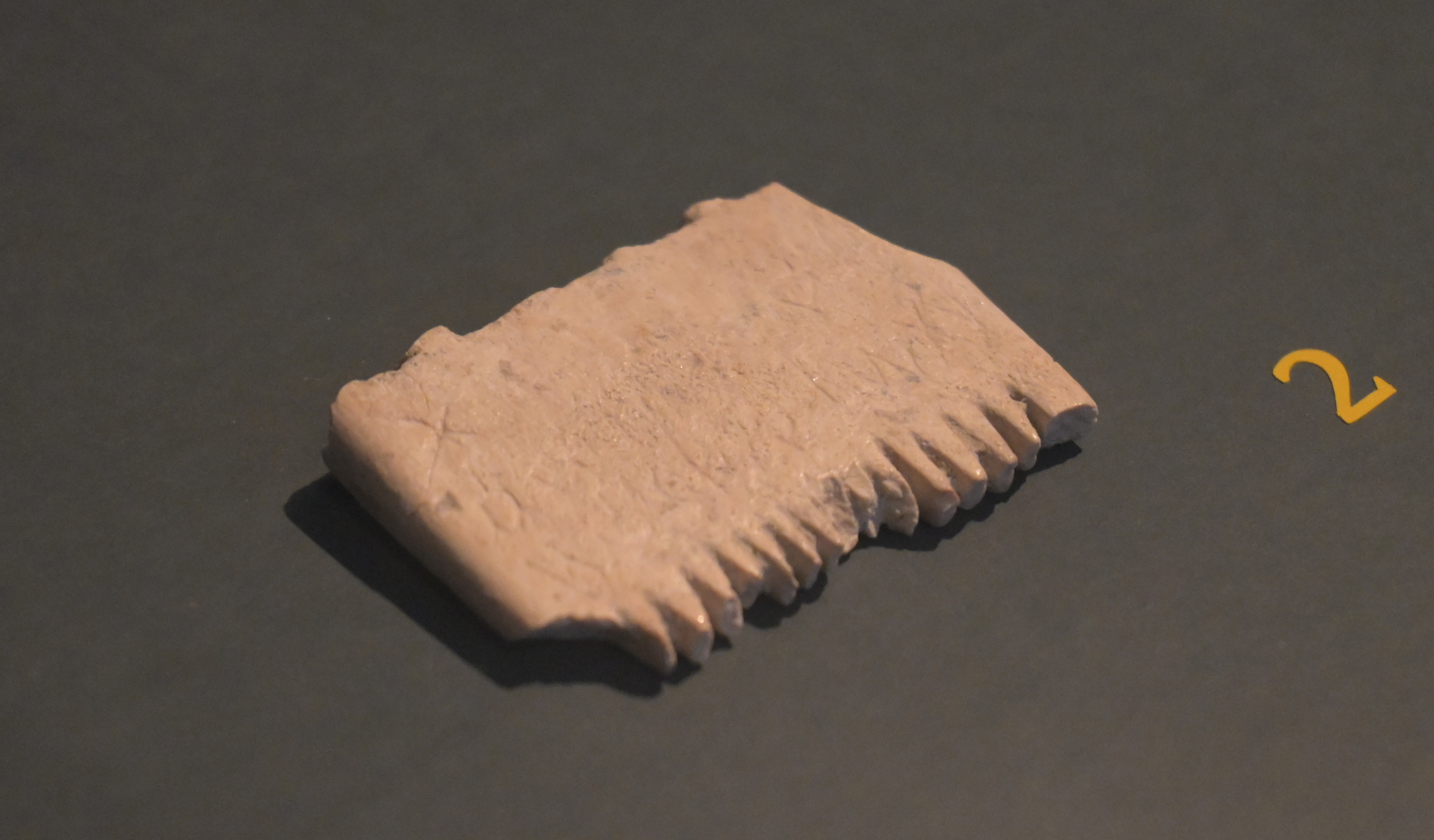
That everyday concern drew me into the story. Someone wanted help with lice, and the wish ended up on the very object used to deal with them. The Hebrew University's announcement describes seventeen letters forming seven words and reports microscopic remains of a louse on the comb. [1]
How old is it? The authors of the original study propose approximately 1700-1550 BCE, more than 3,500 years ago, based on the shapes of its letters. That is a proposed date, and understanding how they arrived at it takes us through the excavation, the recognition of the writing, and the evidence they used for comparison. [2]
Try the inscription
The comb’s early Canaanite sentence
Keyboard
Reading notes
Vainstub et al., p. 90: ytš ḥṭ ḏ lqml śʿ[r w]zqt. Brackets mark restored letters. The editor uses a normalized Hebrew-letter mapping, including ז for ḏ; compare the photograph for the early Canaanite shapes. Source
When was it found, and when was it read?
The original paper by Daniel Vainstub and colleagues records excavation on June 20, 2016, and recognition of the shallow inscription in December 2021. The paper appeared in 2022. The university announcement instead gives 2017 for excavation and 2022 for recognition. This article follows the detailed excavation account in the paper. [2] [1]
That is a useful reason to follow a discovery story back to its source. Finding an object, noticing its writing, reading it, and publishing the study need not happen together. A phrase such as “discovered in 2022” can compress several separate events into one.
When taking notes, give each event its own line. You will be less likely to confuse the modern history of research with the ancient history of the object.
Why the ancient date is an argument
The comb came from a later Iron Age context. The authors argue that it was an older object in a later deposit and date the inscription through comparison of letterforms. Their proposed range is approximately 1700-1550 BCE. Two attempts to obtain a radiocarbon date failed because the carbon was poorly preserved. [2]
The proposed date rests on the authors’ comparison of letterforms.
There are two separate questions here: when was the object made or inscribed, and when did it reach the place where excavators found it? The paper's explanation depends on keeping those questions apart. It also discusses disagreements over the dates of inscriptions used for comparison. [2]
A useful comparison from the same site
A different Lachish inscription, published by Felix Höflmayer and colleagues in Antiquity in 2021, provides a helpful contrast. It is writing on a pottery fragment. The team assigned its deposit to the fifteenth century BCE, using the excavation sequence and radiocarbon measurements on associated barley grains. [3]
The authors describe this fragment as helping bridge a gap in the evidence for early alphabetic writing in the southern Levant. The archaeological association is central to their dating argument. The barley samples help date the deposit containing the fragment. [3]
Comparing these papers is more useful than making the two objects compete for an “oldest” title. Ask what was dated, by which method, and how closely that result connects to the writing. You can then understand why two studies may use different levels of confidence.
Is this already Paleo-Hebrew?
The comb paper calls its script early Canaanite. It should not be relabelled as an example of the fully developed Paleo-Hebrew alphabet simply because it comes from a place later important in Judah. Its relevance is to the earlier history of alphabetic writing. [2]
Unicode's script overview is a useful companion for the later stages. It places Paleo-Hebrew within the script family represented by the Phoenician block and distinguishes that history from the development of square Hebrew. The categories help describe relationships; they should not erase differences between an early inscription and a later alphabet chart. [4]
Use our alphabet guide to learn the later letter correspondences. For the comb, go back to the photographs and drawings in the original article. Do not expect a font to reproduce every early form.
What to carry into the next discovery story
Before sharing the next remarkable inscription, check four things: the object, the excavation context, the proposed reading, and the basis for its date. A short note on each is enough. If one is uncertain, keep that uncertainty in your account.
The comb does not lose its interest when the chronology gets more complicated. A practical object, faint writing, and a careful argument about letterforms are already a good story. There is no need to turn them into a precise date that the evidence did not produce.
Sources and further reading
- Hebrew University of Jerusalem (2022). First Sentence Ever Written in Canaanite Language Discovered at Tel Lachish.
University announcement dated November 13, 2022. Its excavation and recognition dates differ from the primary paper.
- Daniel Vainstub et al. (2022). A Canaanite’s Wish to Eradicate Lice on an Inscribed Ivory Comb from Lachish. Jerusalem Journal of Archaeology 2, 76-119.
Primary study. See pages 80-81 for discovery and recognition; pages 102-103 for dating and unsuccessful radiocarbon tests. DOI: 10.52486/01.00002.4.
- Felix Höflmayer et al. (2021). Early alphabetic writing in the ancient Near East: the missing link from Tel Lachish. Antiquity 95(381), 705-719.
A separate pottery inscription. Its dating discussion provides the comparison used here.
- Unicode Consortium. Unicode 17.0, chapter 10, Phoenician.
Background on the later script family and Paleo-Hebrew encoding.


