
Coinage
How to read a First Jewish Revolt shekel
A silver coin from the Jewish revolt against Rome carries a cup, pomegranates, and two short Hebrew inscriptions. Here is how to start reading them.
In this article
A coin from the revolt against Rome
In 66 CE, Jews in Judaea rose against Roman rule. During the revolt, they issued their own silver coins, including the shekel shown below. A shekel is the coin's denomination, much as a dollar is a denomination today. The cup and pomegranates sit inside rings of Hebrew writing, and those short inscriptions tell us what the coin is and connect it with Jerusalem. [2]
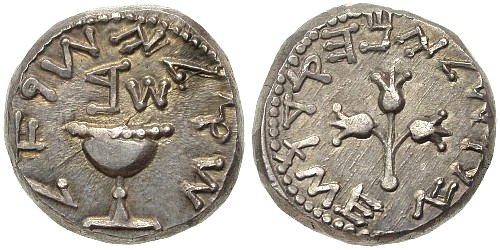
This example belongs to the revolt's second year, 67/68 CE. The letters use Paleo-Hebrew, an older form of the Hebrew alphabet whose shapes differ from the square letters familiar to modern readers. If they look unfamiliar, start with the cup on the left. It gives you a clear way to hold the image upright while you follow the writing around the edge. [3]
For the transcriptions below, I use the Hebrew University's Center for Jewish Art record for another year-two shekel, object 27448. Its description identifies the same cup design, year letters, and inscription. Having both a photograph and a catalogue reading makes this a manageable first encounter with ancient Hebrew on a coin: you can work through one word and then check it. [1]
Try the inscription
Two short inscriptions, two jobs
A coin inscription is often called a legend. The letters above the cup are transcribed in modern Hebrew as שב. In the catalogue, they mean year two. The longer legend is שקל ישראל. The short group dates the issue within the revolt; the longer group names the denomination and Israel. The record assigns this example to 67 CE. [1]
Read the inscription
𐤔𐤒𐤋 𐤉𐤔𐤓𐤀𐤋
שקל ישראל
Shekel of Israel
Try the first word on its own: shin, qof, lamed. Then move to the second word. Use the typed line to match the letters on the coin. Return to the photograph after each word.
Turn it over
The Bank of Israel's currency exhibition describes the silver revolt coins with a cup on one side and pomegranates on the other. The reverse legend is commonly rendered Jerusalem the Holy. Its account places these silver and bronze issues in the war of 66-70 CE and reads the minting itself as a statement of independence. [2]
Notice how much can fit on a small object: a value, a date, a place, and a set of images. Read them together. It is tempting to make each symbol carry an elaborate hidden meaning, but a useful first pass is much plainer: identify the visible design, copy the letters you can actually see, and compare the catalogue's description.
The exact name of the cup deserves care too. The Center for Jewish Art offers Omer cup? with a question mark. Keep that question mark. Naming a pictured vessel is an interpretation, even when identifying its outline is easy. [1]
An old script on a later coin
Unicode's historical overview distinguishes the Phoenician-script family, including Paleo-Hebrew, from the Aramaic line behind the modern square Hebrew script. It also documents later uses of Paleo-Hebrew. A script's continued or renewed use therefore needs to be considered separately from the age of the language it writes. [3]
That is the useful question to bring back to the coin: why choose these letters for this object? The Bank of Israel places their use alongside Jewish imagery and the political act of striking money during the revolt. Its explanation concerns the coin's public message. [2]
Compare another example before you generalize
Nickle Galleries at the University of Calgary publishes photographs of another year-two silver shekel in its numismatic collection. Its caption identifies the chalice, three pomegranates, and ancient Hebrew legend. Use the two museum records side by side. [4]
Can you find the same words on both objects? Where is a stroke clearer on one? Which differences belong to the photographs, and which can you actually see in the coins? It is fine to leave that last question open.
The later Bar Kokhba revolt produced another series of coins. The Bank of Israel treats the 132-135 CE issues separately and describes their practice of striking new designs over existing coins. Use the legends and designs to distinguish the two series. [2]
For your next pass, use the printable alphabet chart and cover the catalogue transcription. Read one word, uncover the answer, and try again. A short legend you can check is better practice than a long one you can only guess.
Sources and further reading
- Center for Jewish Art, Hebrew University. Coins of the Jewish War, object 27448.
The principal coin record for the reading exercise, including the year letters and cup description.
- Bank of Israel. Currency exhibition, part 3.
Institutional overview of the First Revolt and Bar Kokhba coin series.
- Unicode Consortium. Unicode 17.0, chapter 10, Phoenician.
Reference for script relationships and the encoding used in the typed example.
- Nickle Galleries, University of Calgary. Coins of Jesus: Money and Religion in the Ancient World.
A second documented year-two shekel with collection photographs, curated by Marina Fischer.


