
Coinage
New Hebrew words on old Roman money
Bar Kokhba’s coins gave existing money new images and Hebrew inscriptions. A bronze coin and a surviving Roman portrait show how much a small surface can carry.
In this article
A coin with an earlier life
What happens to a ruler’s portrait when someone stamps a new design over it? That question drew me into the coins of the Bar Kokhba revolt, a Jewish uprising against Roman rule in Judaea that began in 132 CE. The rebel authorities made silver and bronze money by striking new designs onto existing coins. The Bank of Israel’s exhibition explains this reuse as a political statement as well as a way to produce currency. [2]
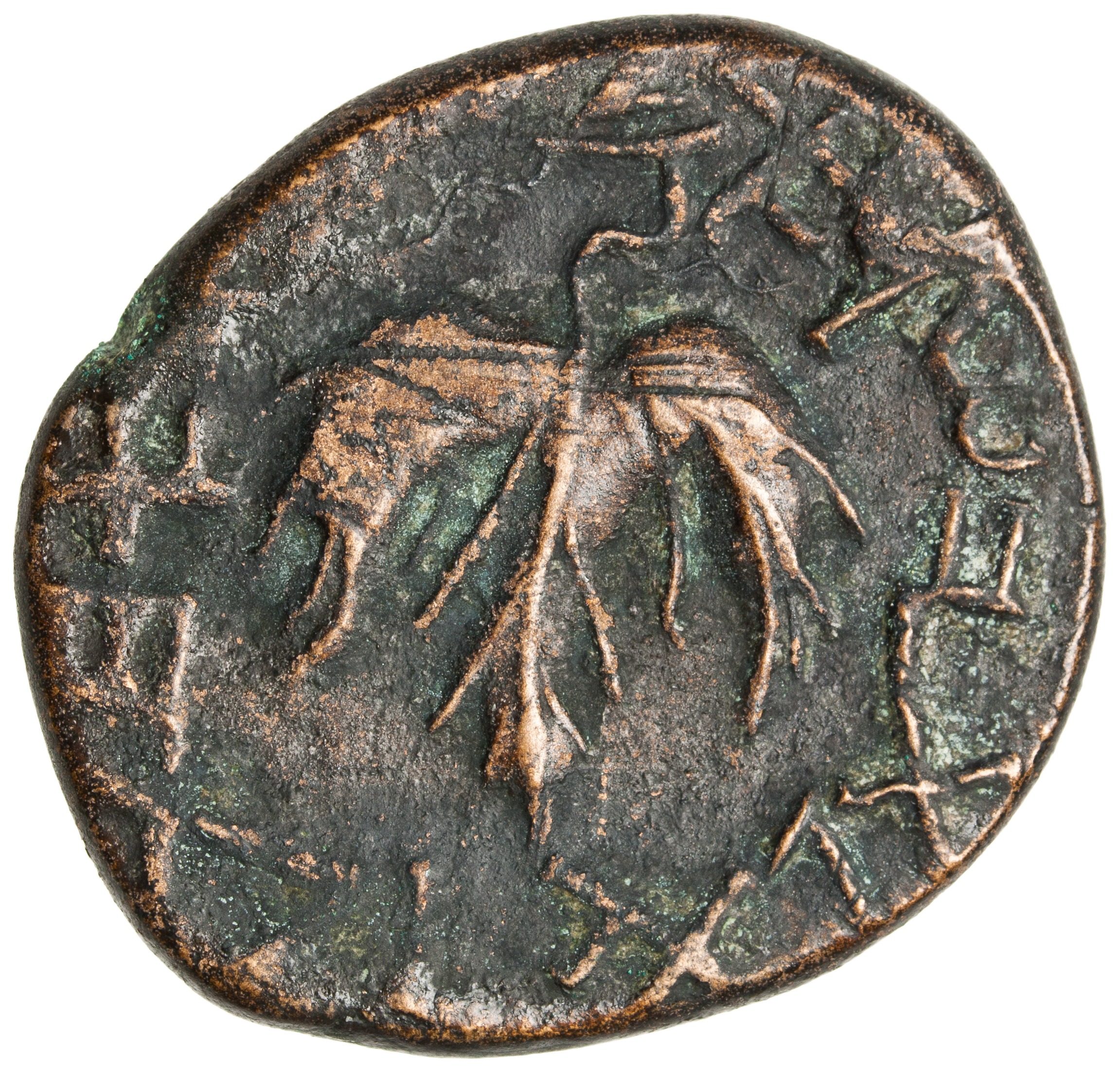
The bronze coin pictured here belongs to that revolt. The American Numismatic Society dates it to 132/133 CE and records a diameter of 26 millimetres, about an inch. A palm tree fills one side; a vine leaf fills the other. Hebrew words curve around both designs. The museum’s photographs and transcriptions let us follow the new message before looking at an example where an older image survives beneath it. [1]
Try the inscription
Palm side
Keyboard
Reading notes
Simon, leader of Israel. Complete legend after ANS 2010.76.11; final nun is normalized to נ for the ancient-script display. Source
Vine-leaf side
Keyboard
Reading notes
Year one of the redemption of Israel. Complete legend after ANS 2010.76.11, with its spelling preserved. Source
A name on one side, a beginning on the other
The palm-side inscription reads שמעון נשיא ישראל: Simon, leader of Israel. The name refers to the revolt’s leader, usually called Bar Kokhba. The title nasi can be rendered prince or leader; the Bank of Israel uses president. Those English choices point to the same Hebrew title, though they can suggest very different offices to a modern reader. [1] [2]
On the vine-leaf side, the catalogue gives שנת אחת לגאלת ישראל, year one of the redemption of Israel. I like the way these two sides work together. One names an authority; the other asks the person holding the coin to count time from a new beginning. The date belongs to the revolt’s own calendar. [1]
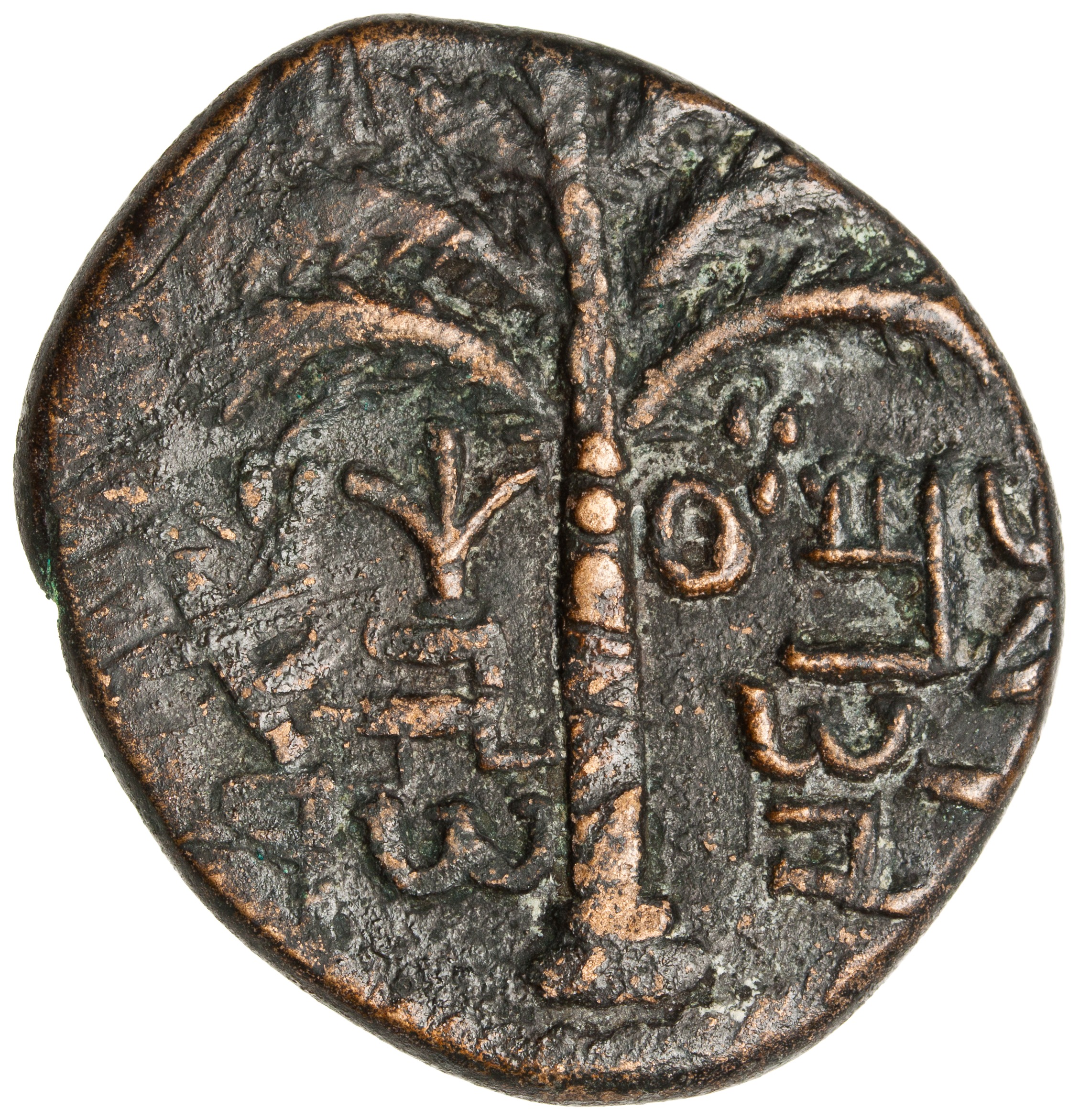
The tools above keep the catalogue’s consonants, including the spelling לגאלת. You can copy either script, compare letterforms, or open the text in the converter. The square Hebrew line gives you a way into the words while the photograph keeps the irregular surface and worn letters in view.
The portrait that remained
The technical word for stamping a fresh design onto an existing coin is overstriking. The University of Michigan’s teaching collection describes the replacement of Roman imagery with Jewish symbols as another expression of rebellion. It helps to picture two separate moments of manufacture: someone first made the money that circulated under Roman rule, and another workshop later gave that metal a new public identity. [3]
For a particularly clear documented example, turn to the Ashmolean Museum’s silver tetradrachm HCR6354. A tetradrachm is a coin denomination. The museum identifies traces of the emperor Trajan’s portrait beneath the later design on its reverse. The new inscriptions name Simon and call for Jerusalem’s freedom. Here the earlier ruler remains part of the object even after the surface has received a different message. [4]
That detail changed how I looked at the photographs. At first I paid attention only to the boldest outlines and the words the catalogue supplied. An overstrike invites a second look at marks that seem to belong nowhere. On HCR6354, the museum has identified an earlier portrait. For the bronze coin shown in this article, the ANS record gives no identification of an underlying coin, so its earlier design remains an open question.
Jerusalem as a goal
The Ashmolean’s silver coin also carries an image of the Jerusalem Temple. The museum explains that the Romans had destroyed the Temple in 70 CE, decades before this revolt, and connects its appearance on the coin with hopes for rebuilding it. An image on money can therefore look forward to a desired future while drawing on a remembered building. [4]
This matters when reading a place name. Jonathan Bourgel’s 2024 study of the silver coin designs reviews the interpretation of references to Jerusalem as aspirations to recover the city. His note 15 explains why scholars widely reject treating the name alone as proof of conquest. The words tell us what the issuing authority wanted people to see; evidence for control of a city requires a further argument. [5]
There is a useful catalogue caution here, too. The ANS database assigns the bronze coin’s production place to Jerusalem. That field gives a catalogue attribution, while the historical question of where the rebels minted their money needs its own evidence. I have described the coin here as an issue of the revolt in Judaea and kept its museum identifier beside the photographs so that readers can check the record directly. [1] [5]
Back to the letters
The ancient alphabet was a deliberate part of these objects. The Ashmolean notes that the script already looked archaic in the second century CE. The Bank of Israel places it alongside the revolt’s Jewish imagery and declarations of independence. The letters, the words, and the reused metal all contribute to what the coin communicated. [2] [4]
After reading the museum accounts, I keep returning to the contrast between a new beginning in the inscription and an earlier life in the metal. The bronze coin gives us a name and a first year to read. The Ashmolean example adds a surviving portrait to that story. Together they make the act of striking a coin feel unusually concrete: a new message had to occupy a surface that already carried someone else’s.
Sources and further reading
- American Numismatic Society. Bronze coin of Simon bar Kokhba, 2010.76.11.
Complete object record reviewed: both Hebrew legends, photographs, dimensions, date, acquisition, and image rights. Its Jerusalem mint attribution is distinguished from demonstrated mint location in the article.
- Bank of Israel. Currency exhibition, part 3: Bar Kochva Revolt.
Institutional account of reused coins, ancient Hebrew inscriptions, and their political setting.
- University of Michigan. Jerusalem: Bar Kokhba coins.
Teaching collection used for the explanation of overstriking and political autonomy. The specific illustrated coin’s dating is not used here.
- Ashmolean Museum, University of Oxford. Tetradrachm, Judaea, HCR6354.
Detailed institutional description of a separate silver coin, including the surviving Trajan portrait and the Temple imagery.
- Jonathan Bourgel (2024). A Representation of the Inauguration Ceremony of the Restored Temple? Harvard Theological Review 117(2), 250-267.
Introduction and description consulted; note 15 reviews the limits of using Jerusalem legends as evidence of conquest. The article’s proposed ritual interpretation is not adopted here.